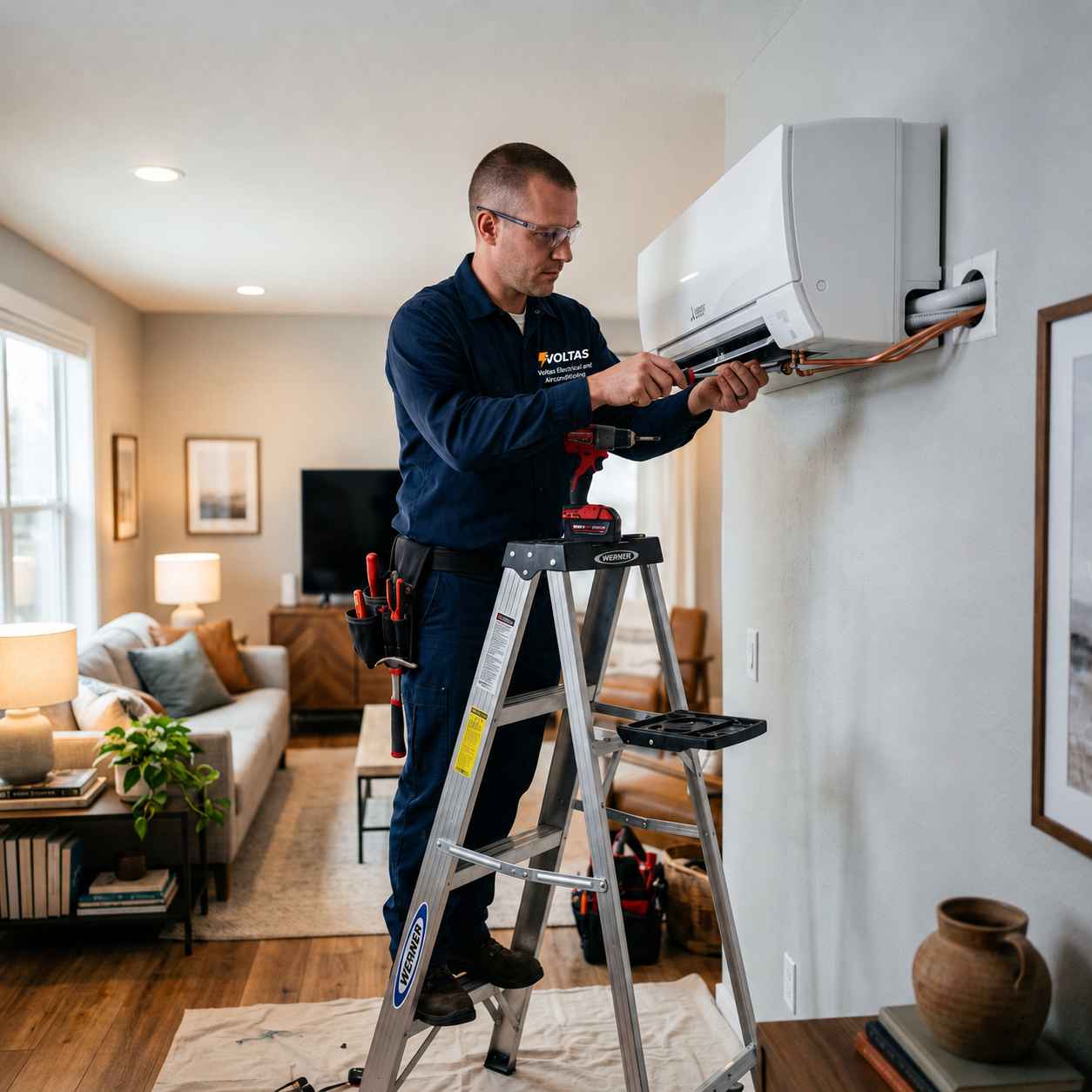
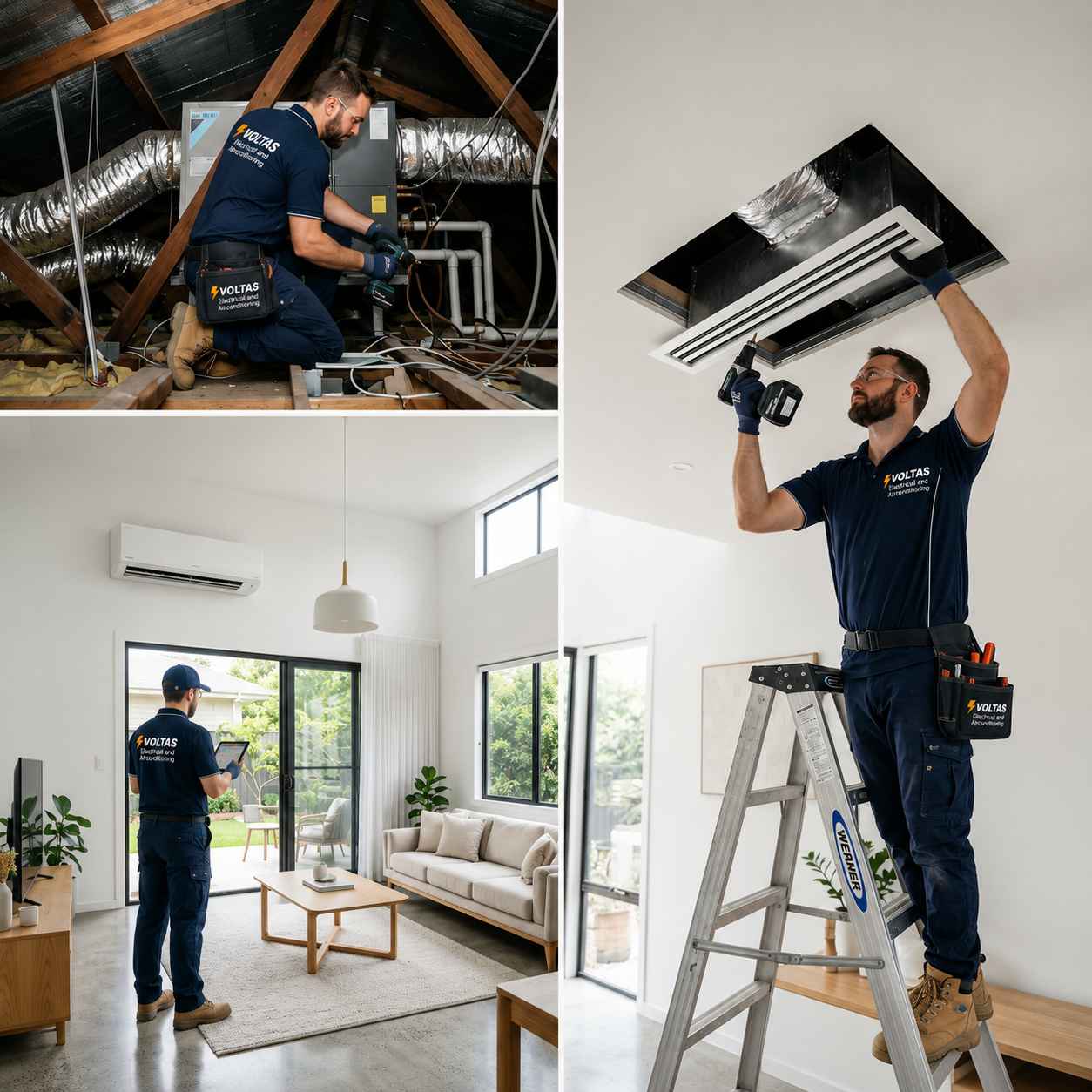
There's nothing more frustrating than standing under a vent on a stinking-hot Adelaide afternoon, air conditioner clearly running, and feeling nothing but lukewarm breeze. It's one of the most common calls we get across Adelaide's suburbs every summer — the unit powers on, the fan spins, the remote says "cool," but the room just won't drop in temperature. The good news is that in most cases the cause is one of a small, predictable list of faults, and several of them are things you can check yourself in five minutes before booking a repair.
Voltas Electrical & Airconditioning has been diagnosing and repairing air conditioners across Adelaide since 2010, holding BLD 274739 · PGE 265145 · AU 61210, with 24/7 emergency response and same-day appointments the norm during the peak of summer when "not cooling" calls spike. Below is the full list of causes we actually find on-site, in the order we check them, so you know what's likely going on before a technician even arrives. If the unit isn't responding to the remote at all rather than just failing to cool, our separate air conditioner remote troubleshooting guide covers that specific problem.
1. A dirty or clogged air filter
This is the single most common cause of reduced cooling, and it's the first thing every technician checks. A filter clogged with dust, pet hair, or pollen restricts airflow across the indoor coil, which can cause the coil to ice up and starve the room of cooled air even though the compressor is running fine. Adelaide's dry, dusty summers and periods of bushfire smoke haze make filters clog faster than in more humid climates. Most split-system filters simply slide out and can be rinsed under a tap or vacuumed — as a rule of thumb, check them every 4-6 weeks over summer.
2. A blocked or dirty outdoor unit
The outdoor condenser unit needs clear airflow on all sides to release the heat pulled out of the house. Leaves, grass clippings, spiderwebs, and general dust buildup on the condenser coil are extremely common in Adelaide properties, especially units tucked against a side fence or under a tree. A unit fighting for airflow works harder, cools less effectively, and wears out faster. Keep at least 300-500mm of clearance around the outdoor unit and hose down the coil fins gently (never with a pressure washer) a couple of times a year.
3. Low refrigerant from a gas leak
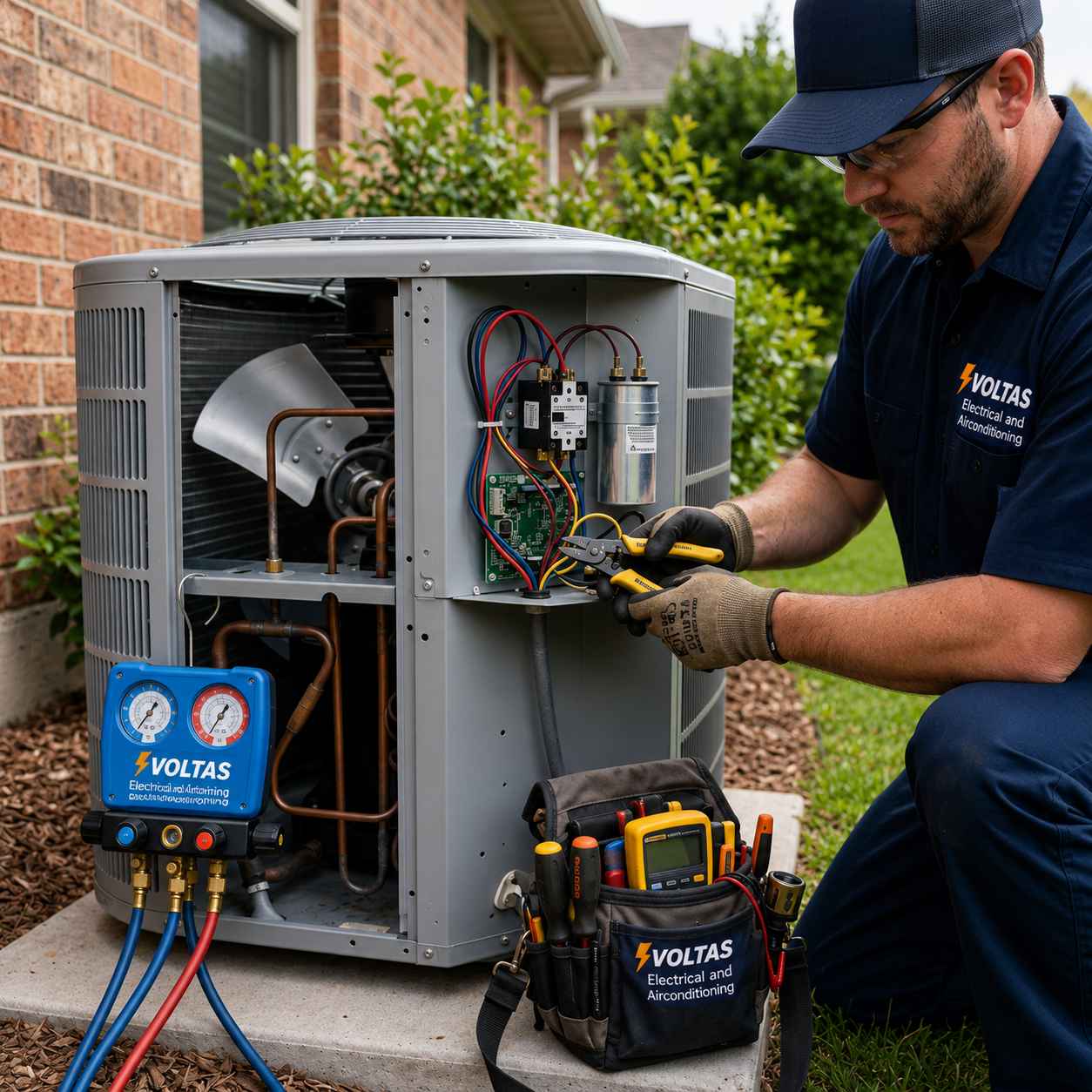
Refrigerant doesn't get "used up" in a healthy system — if the level is low, it's leaking somewhere, usually from a joint, valve, or a small corrosion point in the coil. Low refrigerant means the system can't absorb heat properly, and it often shows up as ice forming on the indoor unit, a hissing sound, or air that's cool but nowhere near as cold as it should be. This is not a DIY fix: refrigerant gas is tightly regulated in Australia, and only a technician holding an ARCtick refrigerant handling licence can legally locate the leak, repair it, and regas the system. If you suspect low refrigerant, our air conditioning repair team can pressure-test and regas the system properly rather than just topping it up, which only masks the leak temporarily.
4. A failing or overworked compressor
The compressor is effectively the heart of the system, pumping refrigerant around the circuit. A compressor nearing the end of its life — often after 10-15 years of Adelaide summers — can run continuously without ever reaching the set temperature, draw more power than usual, or trip on its own internal overload protection. Compressor issues are usually the costliest fault to repair and, depending on the unit's age and the cost of a compressor replacement versus a new system, this is often the point where we'll give you an honest comparison of repair versus replacement rather than just booking a costly part swap.
5. Closed or blocked vents and dampers
For ducted systems especially, closed zone dampers or vents blocked by furniture, curtains, or rugs starve individual rooms of airflow while the rest of the house cools normally. This is one of the easiest things to check yourself — walk the house and confirm every vent in the affected room is open and unobstructed. If you're weighing up whether a ducted system's zoning is set up correctly for your home in the first place, our ducted air conditioning guide for Adelaide homes covers how zoning and duct sizing affect cooling performance room by room.
6. A faulty thermostat or temperature sensor
If the thermostat or the unit's internal temperature sensor is misreading the room, the system can think it's already reached the set temperature and cycle off early, or run inefficiently trying to chase an inaccurate reading. This often shows up as a room that cools inconsistently — cold near the unit, warm everywhere else — rather than not cooling at all.
7. A unit that's simply undersized for the space, or overwhelmed by extreme heat
Not every "not cooling" call is a fault. On days the Bureau of Meteorology forecasts 40°C+ for Adelaide, even a healthy, well-maintained unit can struggle to hold a room at 22-23°C during the late afternoon peak, particularly in an older, poorly insulated home that's absorbed heat all day. If a unit was undersized for the room at installation, this gap becomes obvious every summer rather than just on the worst days. We saw exactly this pattern with a customer in Morphett Vale whose original split system had been sized for a smaller living area before an open-plan renovation — the fix wasn't a repair at all, but a correctly sized replacement unit.
Not sure which of these is causing your problem? We diagnose the exact fault on-site rather than guessing.
Get a Same-Day QuoteWhat to check yourself before calling a technician
A handful of quick checks can save you a call-out fee if the cause turns out to be something simple:
- Check and clean the indoor air filter.
- Clear leaves, debris, or overgrown plants from around the outdoor unit.
- Confirm all vents and zone dampers in the affected room are open.
- Check the thermostat is set to "cool" mode, not "fan" mode, and the set temperature is actually below room temperature.
- Check the circuit breaker for the unit hasn't tripped.
If the unit still isn't cooling properly after these checks, or you notice ice on the indoor coil, a hissing sound, or a burning smell, stop using it and call a licensed technician — running a low-refrigerant or electrically faulty unit can cause further damage to the compressor.
When it's time to call a licensed technician
Anything involving refrigerant gas, wiring, the compressor, or a circuit board is not a DIY repair — and in the case of refrigerant, it's not legal to handle without an ARCtick licence in Australia. Our AC service & repair technicians carry parts for all major brands on every van, including Daikin, Mitsubishi Electric, Fujitsu General, LG, and the other major manufacturers we service, so most faults are diagnosed and fixed in a single visit. We had a similar case recently in Salisbury, where a split system blowing warm air turned out to be a slow refrigerant leak at a flare joint — a 40-minute fix once correctly diagnosed, rather than the compressor replacement the homeowner had feared.
Regular maintenance catches most of these faults before they leave you without cooling on the hottest day of the year. If your system hasn't had a professional service recently, our AC maintenance service includes a filter clean, coil inspection, refrigerant pressure check, and electrical safety check, and our guide on how often to service your air conditioner in Adelaide sets out a realistic yearly schedule so this doesn't catch you out again.
Frequently Asked Questions
Why is my air conditioner running but not cooling the room?
The most common cause is a dirty air filter or blocked outdoor unit restricting airflow, followed by low refrigerant from a slow gas leak. Both stop the system from absorbing and releasing heat properly, even though the fan and compressor sound like they're working normally.
Can I fix an air conditioner that isn't cooling myself?
You can safely check and clean the air filter, clear leaves or debris from around the outdoor unit, and make sure all vents are open. Anything involving refrigerant, electrical faults, or the compressor requires a licensed technician, since handling refrigerant gas without an ARCtick licence is illegal in Australia.
Why does my air conditioner blow warm air during Adelaide summer heatwaves?
On extreme 40°C+ days, an undersized, ageing, or already-strained unit can struggle to keep up with demand even without a fault, especially in the late afternoon when the whole house has absorbed heat all day. If the unit blows warm air on a mild day too, that points to a genuine fault like low refrigerant rather than the outside temperature.
How much does it cost to fix an air conditioner that's not cooling in Adelaide?
A straightforward fix like a filter clean or capacitor replacement is typically inexpensive, while a refrigerant regas or compressor-related repair costs more depending on the fault and system size. Voltas diagnoses the exact cause first and provides a same-day, obligation-free quote before any repair work begins.
Air Conditioner Not Cooling Properly? We'll Find Out Why.
Our Adelaide technicians diagnose the exact cause on-site and give you a same-day, obligation-free quote before any work begins.
Sources referenced include the Bureau of Meteorology (bom.gov.au) for Adelaide summer temperature context and industry ARCtick refrigerant handling licensing requirements.
Disclaimer: This article is provided as general information and guidance only. It draws on publicly available sources, government and industry publications (referenced where relevant), and Voltas Electrical Adelaide's own trade experience — it is not personalised advice for your specific property and does not replace a licensed, on-site assessment. Regulations, pricing, and product or brand details can change over time, so please independently verify anything relevant to your decision and seek your own professional advice before acting. To the fullest extent permitted by law, Voltas Electrical Adelaide accepts no responsibility or liability for any loss, damage, or other outcome arising from reliance on the information in this article. Where this article refers to a same-day or obligation-free quote or assessment, that refers to the quote or assessment itself — a site visit to a property well outside our normal Adelaide metro service area may incur a travel or call-out fee, as set out in our Terms & Conditions, which also has full details on the points above.