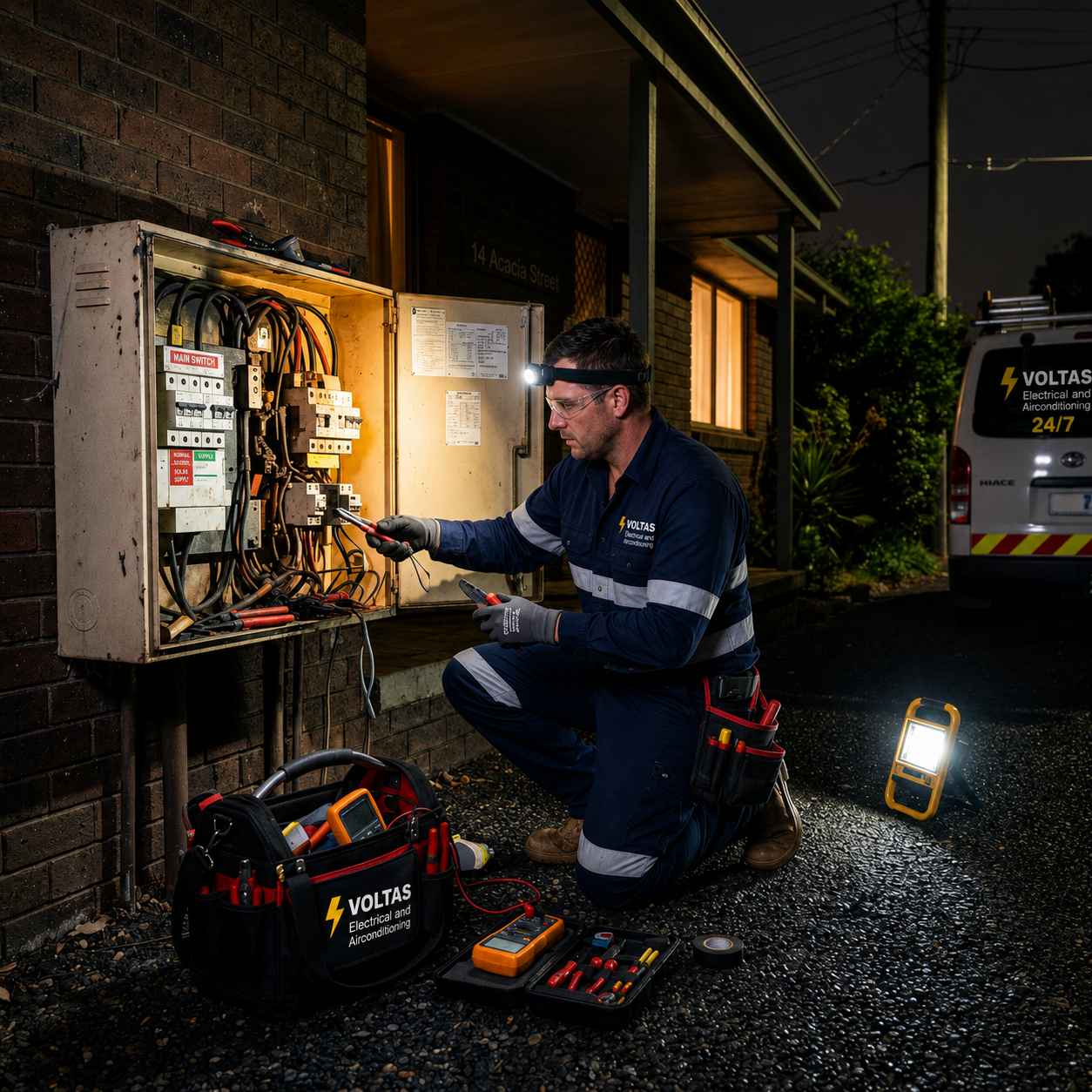
Solar and battery quotes tend to focus on panels, battery capacity, and payback periods — understandably, since that's what sells the system. What often gets skipped is a genuinely important question: does your home's electrical infrastructure, starting with the switchboard, actually have the capacity to take on a solar inverter and a battery safely? In plenty of established Adelaide homes, particularly those with an older board, the answer is "not without some work first" — and finding that out mid-installation is a far worse experience than finding out during the quote.
We're Voltas Electrical & Airconditioning, a licensed Adelaide electrical team (licences BLD 274739, PGE 265145, AU 61210) that assesses and upgrades switchboards ahead of solar and battery installs across Adelaide metro. This guide covers South Australia's specific export rules, the current federal battery rebate, how to tell if your switchboard is ready, and honest 2026 Adelaide costs.
Why Your Switchboard Matters Before Solar or a Battery
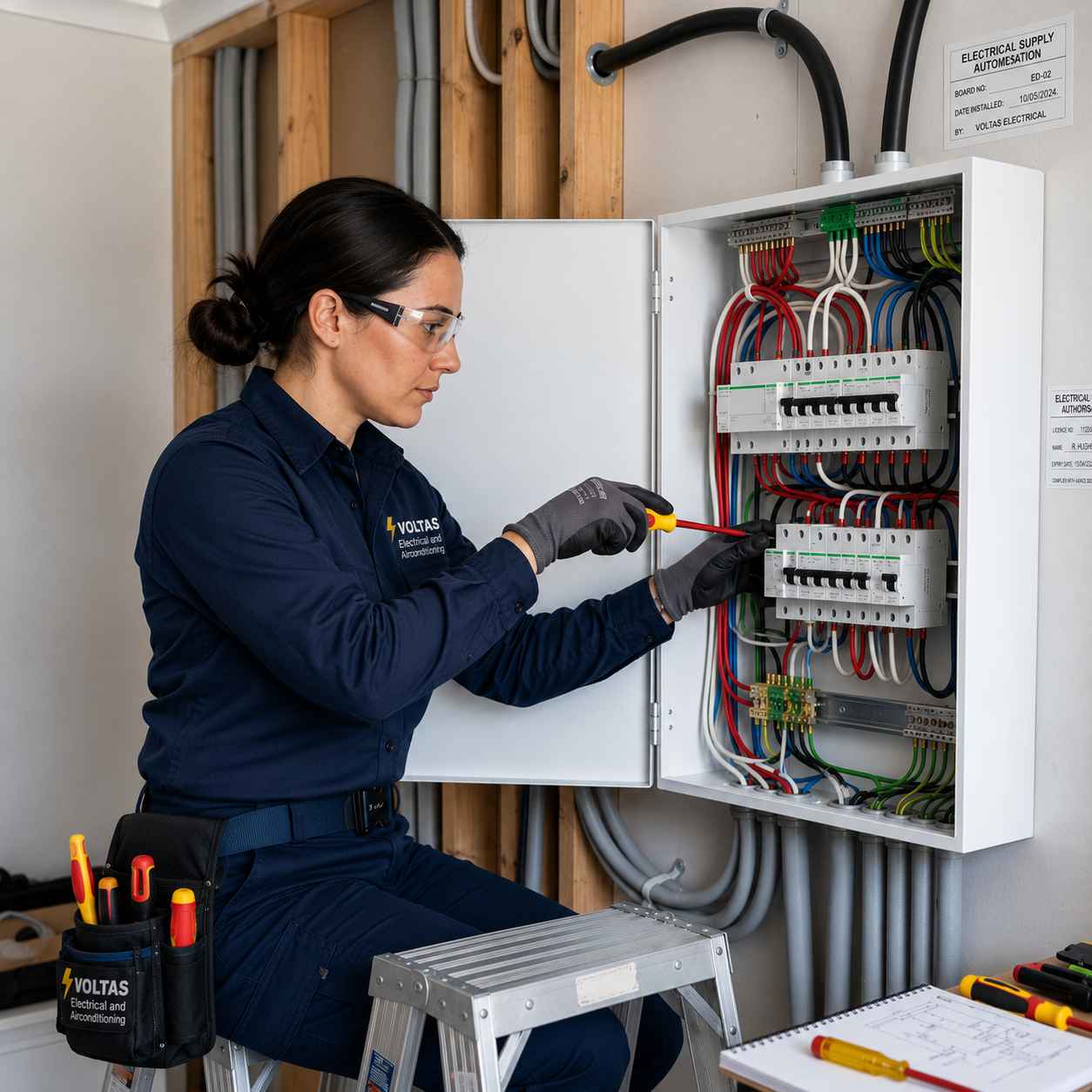
Adding solar, and especially a battery, is a genuinely bigger electrical load and a more complex piece of switching infrastructure than most homeowners expect — often comparable to, or bigger than, adding an EV charger. Our switchboard upgrade guide covers the general warning signs an older board is overdue for attention (ceramic fuses instead of breakers, no safety switches, frequent trips), but solar and battery installs raise the stakes specifically: they need dedicated switching and metering capacity that a board built decades ago, long before either technology existed, usually just doesn't have room for.
Your board still uses ceramic fuses
Pre-dates modern breakers and safety switches entirely — almost always needs replacing before solar or a battery can be added.
No spare circuit space
A fully populated board has no room left for the extra breakers a solar inverter and battery both need.
Single-phase power, but you want a larger system
Bigger solar or battery systems often need three-phase power — a separate assessment from the switchboard itself.
No safety switches (RCDs) fitted
A basic safety requirement for any modern electrical work, and commonly missing on boards from before the early 1990s.
South Australia's Dynamic Export Rule (Since 1 July 2023)
South Australia has its own specific requirement for new and upgraded solar systems: since 1 July 2023, any new solar installation must use a compatible, internet-connected inverter supporting what SA Power Networks calls "Flexible Exports" (also known as Dynamic Export Limits). Rather than a fixed, always-on export cap, a compliant system can export up to 10kW of solar back to the grid per phase, with the actual allowed level adjusted automatically and in real time based on grid conditions — working more like a dimmer switch than an on/off limit. Without a compliant, connected inverter, your system is instead capped at a flat, much lower export limit (1.5kW or, in some areas, 0kW). In practice, this means confirming with your solar installer that the inverter they're proposing is genuinely Dynamic Export-compliant, not assuming any inverter on the market qualifies.
The Federal Battery Rebate — and What Happened to SA's Own Scheme
If you've heard about "the battery rebate" but aren't sure which one still applies, here's the current picture. South Australia ran its own Home Battery Scheme, but it closed to new applicants in September 2022 and hasn't reopened. The rebate now available is the federal Cheaper Home Batteries Program, which launched 1 July 2025 and applies Australia-wide, including South Australia. It gives an upfront discount on eligible battery systems between 5kWh and 100kWh, calculated per kilowatt-hour of usable capacity: broadly around 30% off the first 14kWh, tapering off for capacity between 14kWh and 28kWh, tapering further from 28kWh to 50kWh, and no rebate at all above 50kWh. As a rough guide, a 10kWh system typically saves in the order of $2,500, and a 21kWh system in the order of $4,500 — though the exact per-kWh rate steps down gradually over time, so get a current figure with your quote rather than relying on last year's number. To qualify, the battery and inverter need to be on the Clean Energy Council's approved product list, installed by an accredited installer, alongside an existing or new solar system, with one rebate per address. South Australian households may also be able to stack a Virtual Power Plant incentive through the state's Retailer Energy Productivity Scheme on top of the federal rebate — worth asking your installer about specifically, since it's separate from the federal program.
Want to know if your switchboard can handle solar and a battery before you commit to a quote?
Get a Same-Day Assessment2026 Cost of Solar & Battery Storage in Adelaide
Based on current Australian market pricing (after the federal battery rebate, where eligible), here's a realistic starting point by battery size:
~10kWh battery
$3,700–$7,000A common entry-level size for a typical Adelaide household.
13–15kWh battery
$4,500–$7,100The most common size range for family homes wanting solid evening coverage.
16–20kWh battery
$4,900–$9,300For larger homes or higher evening power use.
Switchboard upgrade (if needed)
$1,200–$5,000+A separate cost — see our switchboard guide for the full 2026 pricing breakdown.
Larger batteries generally cost less per kilowatt-hour thanks to fixed costs (inverter, controller, installation labour) spreading across more storage capacity — but the switchboard is the line item most quotes leave out until the electrician actually inspects your board. If yours turns out to need an upgrade too, our switchboard guide has the current 2026 Adelaide pricing for that job specifically, including the three-phase switchboard pricing relevant to larger solar and battery systems.
Adding a Battery to Existing Solar, or Planning Both Together?
If you already have solar and are adding a battery later, your existing switchboard and inverter setup both need checking against current requirements — an older solar install may predate the Dynamic Export rule entirely and need an inverter upgrade alongside the battery. If you're planning solar and a battery together from scratch, or building new, it's worth having your switchboard and electrical capacity assessed as one project rather than three separate afterthoughts, the same way we'd recommend planning ahead for EV charger capacity if that's on your radar too — all three draw on the same limited switchboard real estate.
Which Adelaide Homes Should Get Assessed First?
We see switchboard capacity issues most often in established suburbs like Modbury and Hope Valley, where original switchboards from a home's first build are still common and were never designed with solar, let alone a battery, in mind. If your home falls into that category and solar or a battery is on your radar for the next year or two, a switchboard assessment now is a small, worthwhile step before you commit to a system quote.
Frequently Asked Questions
Do I need a switchboard upgrade before installing solar or a battery in Adelaide?
Often, yes, especially in established Adelaide homes. Solar and battery systems typically need additional switching and metering capacity, and older switchboards with ceramic fuses or no spare circuit space usually can't accommodate them safely. It's worth having your switchboard assessed as part of planning the installation, rather than discovering a limitation partway through the job.
What is South Australia's Dynamic Export requirement?
Since 1 July 2023, any new or upgraded solar installation in South Australia must use a compatible, internet-connected inverter that supports Flexible (Dynamic) Exports. This lets you export up to 10kW of solar back to the grid per phase, with the actual level automatically adjusted in real time based on grid conditions. Without a compliant, connected inverter, export is instead capped at a flat, much lower limit.
Is there still a South Australian government rebate for home batteries?
No, South Australia's own Home Battery Scheme closed in September 2022 and hasn't reopened. The main incentive now available is the federal Cheaper Home Batteries Program, which launched 1 July 2025 and gives an upfront discount of roughly 30% on the first 14kWh of an eligible battery, tapering for larger systems and phasing down gradually over time. South Australian households may also be able to stack a Virtual Power Plant incentive on top of the federal rebate.
How much does solar and battery storage cost in Adelaide in 2026?
A mid-sized 10kWh battery typically costs $3,700–$7,000 installed after the federal rebate, a common 13–15kWh system runs roughly $4,500–$7,100, and larger 16–20kWh systems are usually $4,900–$9,300. These figures are for the battery and its installation only; a switchboard upgrade, if one is needed, is typically a separate cost on top.
Planning Solar or a Home Battery?
We'll assess your switchboard first, confirm exactly what's needed, and give you a clear, itemised quote — before you commit to a solar or battery system.
Guidance cross-checked against SA Power Networks' Flexible Exports guidance, the Australian Government's Cheaper Home Batteries Program details, current Australia-wide battery storage cost surveys, and our own 2026 Adelaide quoting history. If your switchboard itself may need attention before adding solar or a battery, see our guide on when to upgrade your switchboard.
Disclaimer: This article is provided as general information and guidance only. It draws on publicly available sources, government and industry publications (referenced where relevant), and Voltas Electrical Adelaide's own trade experience — it is not personalised advice for your specific property and does not replace a licensed, on-site assessment. Regulations, pricing, and product or brand details can change over time, so please independently verify anything relevant to your decision and seek your own professional advice before acting. To the fullest extent permitted by law, Voltas Electrical Adelaide accepts no responsibility or liability for any loss, damage, or other outcome arising from reliance on the information in this article. Where this article refers to a same-day or obligation-free quote or assessment, that refers to the quote or assessment itself — a site visit to a property well outside our normal Adelaide metro service area may incur a travel or call-out fee, as set out in our Terms & Conditions, which also has full details on the points above.