If you're replacing an old, failing air conditioner or planning cooling for a renovation or new build in Adelaide, you'll hit this exact fork in the road almost immediately: split system, or ducted? Both are reverse-cycle systems that heat and cool, both come from the same handful of trusted brands we install and service, and both technicians will tell you their preferred option is "the right one" — which isn't much help when you're the one signing off on a five-figure decision.
We're Voltas Electrical & Airconditioning, a licensed Adelaide electrical and air conditioning team (licences BLD 274739, PGE 265145, AU 61210) that installs and services both split system and ducted air conditioning across Adelaide metro, every week, in homes ranging from 1960s brick veneer bungalows to brand-new double-storey builds. This guide is the same comparison we walk customers through on-site — real cost ranges, real trade-offs, and a straight recommendation based on your actual home, not a generic "it depends."
What's the Real Difference Between Split System and Ducted Air Conditioning?
Both split system and ducted air conditioners are reverse-cycle heat pumps — they move heat rather than generate it, which is why both are far cheaper to run than old-style electric panel heaters or resistive heating. The difference is entirely in how that conditioned air gets delivered around your house.
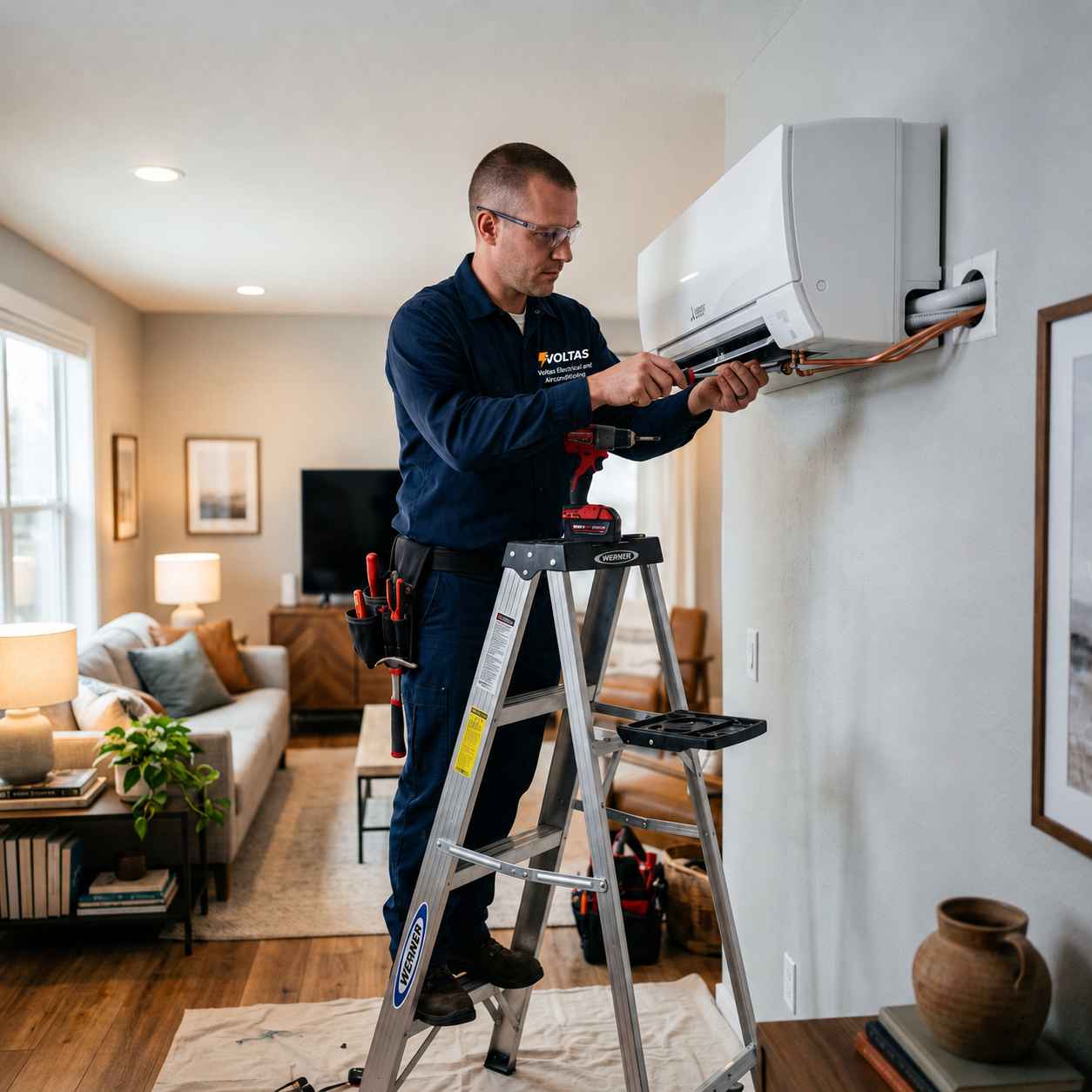
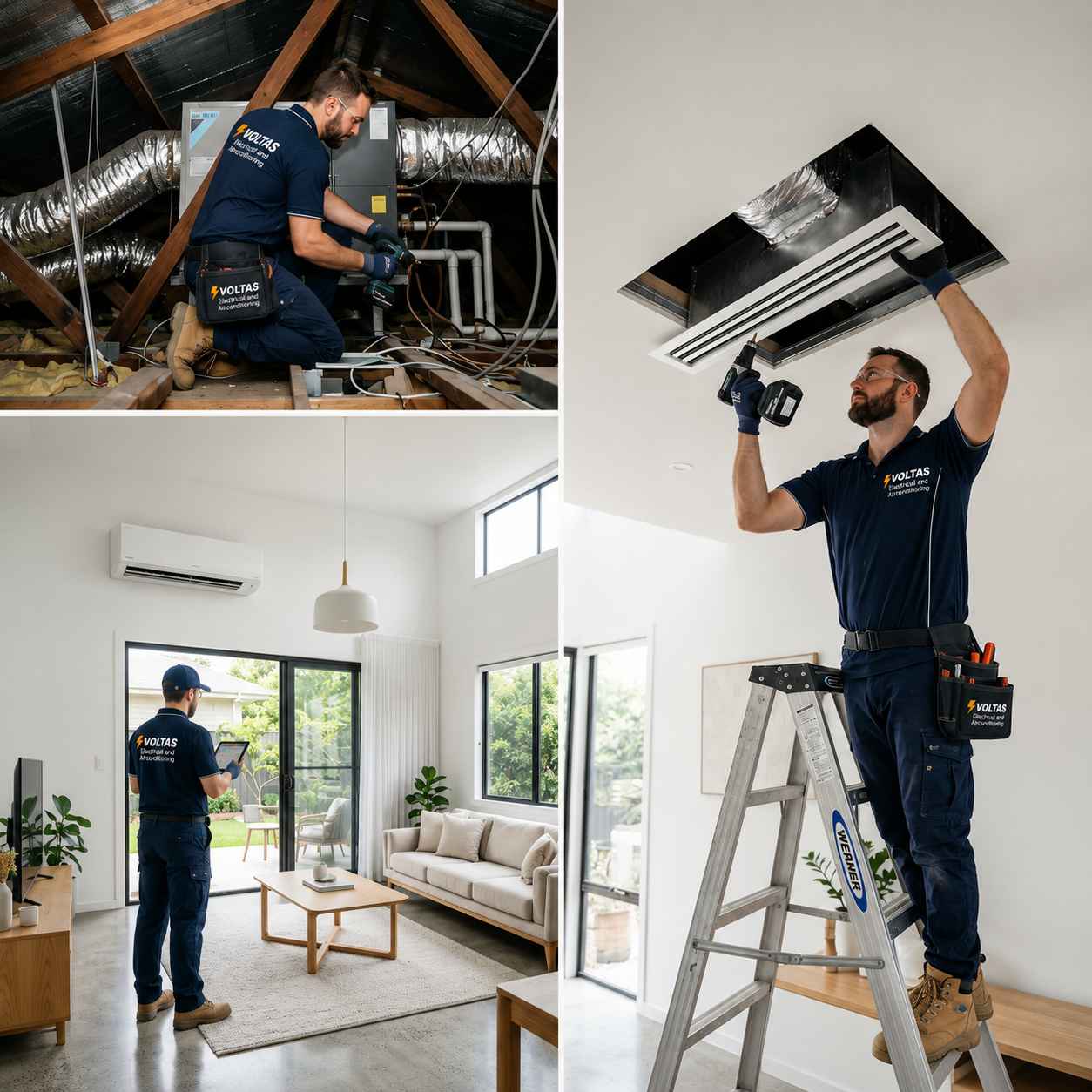
A split system is one outdoor compressor unit connected to one (or occasionally two or three, in a "multi-split" setup) indoor wall-mounted head unit. Each indoor head heats or cools the single room or open-plan area it's mounted in, and nowhere else. A ducted system is one larger outdoor unit connected to a single indoor unit hidden in the ceiling or under-floor space, which pushes conditioned air through a network of ducts to vents in every room you've included in the design — controlled from one central panel or app, usually with the house split into two or more independently-controlled "zones" so you're not heating or cooling empty rooms.
Split System Air Conditioning: Where It Wins
Split systems are the default choice for a single living room, a bedroom, a granny flat, or a home where only one or two areas actually need year-round heating and cooling. The upfront cost is low, installation is fast (often finished in half a day), and because each unit is independent, one breaking down doesn't leave the whole house without climate control.
The trade-off is visibility and coverage: a wall-mounted head unit is a permanent, visible fixture in every room it's fitted to, and if you later want to cool a different room you're paying for another full unit rather than just opening a vent.
You're cooling 1–3 rooms
A single living area, main bedroom, or a small unit/townhouse doesn't need whole-home ductwork.
Budget is the main constraint
A single split system is typically 3–6x cheaper upfront than a whole-home ducted install.
No roof or ceiling access
Some older Adelaide homes (low-pitch skillion roofs, exposed-beam ceilings) simply can't fit ductwork.
You're renting or unsure how long you'll stay
Lower cost and a faster install make split systems a lower-risk choice if you might move in a few years.
Ducted Air Conditioning: Where It Wins
Ducted systems earn their much higher price tag by disappearing completely — no indoor unit on display anywhere, just discreet ceiling vents — and by conditioning the entire home from one thermostat or app, with zoning letting you switch off areas you're not using (say, bedrooms during the day, or a rarely-used formal lounge). For a 3-bedroom-plus Adelaide home used across most rooms, that whole-house comfort and the resale-value bump of a hidden, professionally zoned system is usually worth the extra spend.
The trade-off is cost and access: ducted systems need real ceiling cavity space to run duct runs, which is straightforward in a newer build but can mean extensive (and expensive) retrofitting in an older, low-roof-pitch Adelaide home — occasionally to the point where ducted simply isn't physically viable without a roof rebuild. For the full picture on how sizing, zoning, and retrofit roof-space requirements actually work, see our complete guide to ducted air conditioning.
You want most or all rooms conditioned
Four-plus rooms used regularly usually makes ducted cheaper per-room than four separate split units.
You value a hidden, single-control system
One thermostat or app, zero visible indoor units, and no clutter of remotes.
You're building or doing a major renovation
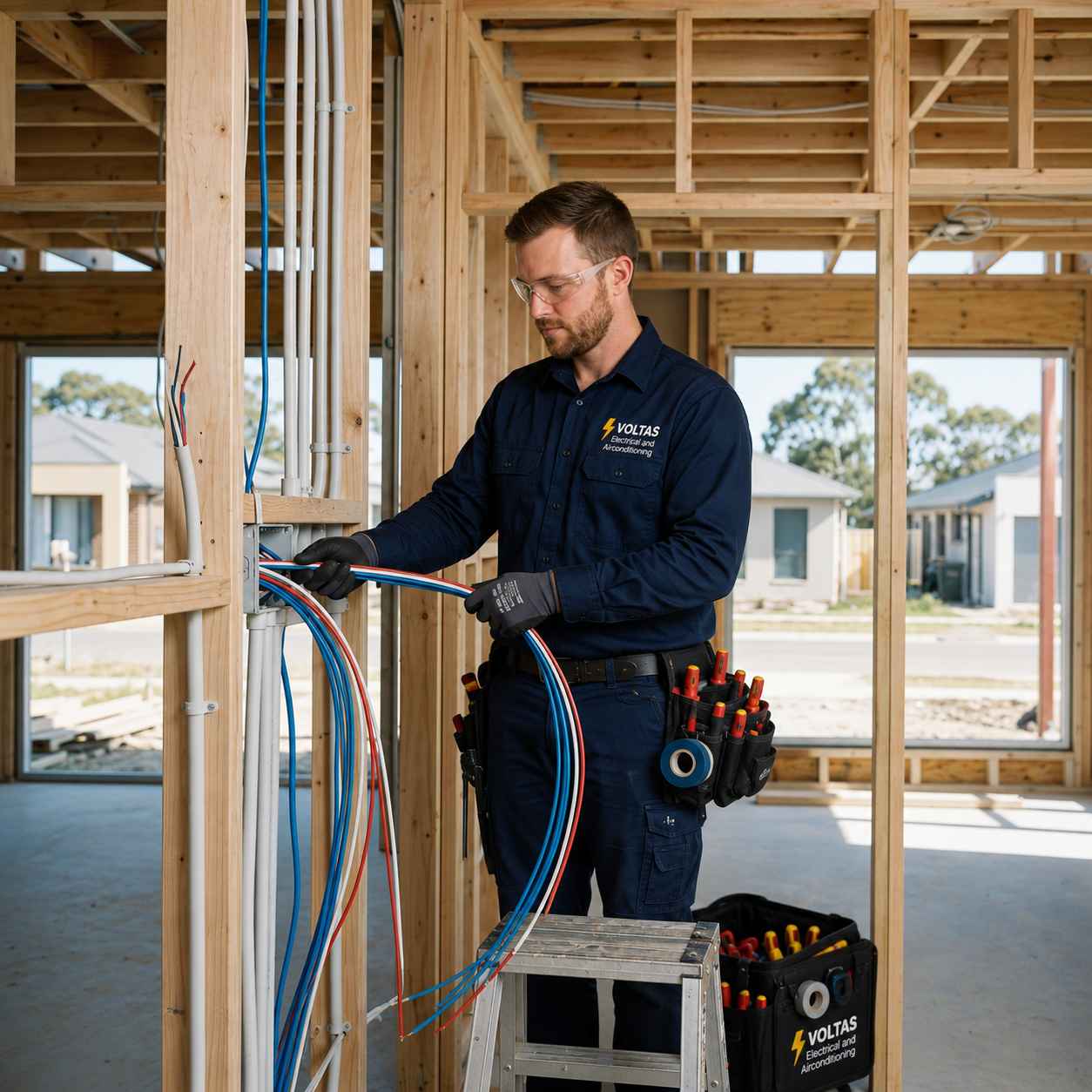
Ducting is far cheaper to install before ceilings and walls are closed up than as a retrofit.
You're planning to sell in the next few years
Ducted air conditioning is a genuine value-add most Adelaide buyers actively look for.
Not sure which fits your floor plan? We'll assess it on-site, obligation-free.
Get a Same-Day Quote2026 Installation Costs in Adelaide: Split System vs Ducted
Every quote depends on your specific home, but based on current Adelaide market pricing, here's a realistic starting point for both options:
Single split system (small room, ~2.5kW)
$1,200–$1,800Supplied and installed, one indoor/outdoor unit.
Single split system (living area, 5–7kW)
$2,200–$3,500Larger capacity for an open-plan living/dining area.
Multi-head split (2–4 rooms)
$4,500–$7,000One outdoor unit running multiple indoor heads.
Ducted — established 3-bed home
$9,000–$14,000Straightforward retrofit with reasonable roof access.
Ducted — 4–5 bed or complex retrofit
$13,000–$18,500+Larger capacity, more zones, or a full duct replacement.
New-build ducted (during construction)
$6,500–$12,000Cheaper than a retrofit — ducting goes in before ceilings close up.
Two things move a ducted quote more than anything else: your home's age (a single-storey, low-pitch roof built before 1990 usually costs more to duct than a newer build with generous roof space) and how many independently-controlled zones you want. A basic 2-zone system will always undercut a fully-zoned 6-zone setup with smart app control. For split systems, capacity (kW) and how many indoor heads you're running off one outdoor compressor are the two biggest cost drivers.
Running Costs & Energy Efficiency: Which Is Cheaper to Run?
Every air conditioner sold in Australia carries an Energy Rating Zoned Energy Rating Label — a star rating (up to 10 stars for both heating and cooling) calculated across three climate zones, so you can compare genuine running-cost efficiency between models rather than guessing from the sticker price alone. A higher star rating in the "hot" zone rating specifically is the one worth checking for Adelaide's climate.
As a rough annual running-cost guide for typical use: a single well-sized split system running one or two rooms usually costs somewhere in the $600–$1,000 a year range, while a whole-home ducted system used across a typical 4-bedroom house lands closer to $800–$1,400 a year — though a well-zoned ducted system that only conditions occupied rooms can close that gap considerably. South Australia's electricity tariffs are among the highest of any state, so the efficiency star rating matters more here than in most of the country — it's worth paying more upfront for a higher-star unit if you're running it daily through an Adelaide summer.
Adelaide's summers are genuinely demanding on any air conditioner: the Bureau of Meteorology recorded Adelaide's Summer 2025 mean maximum temperature at 2.4°C above the long-term average, with parts of the metro area reaching the mid-40s on the hottest days. Undersizing a system to save money upfront is one of the most common — and most expensive in the long run — mistakes we see, since an undersized unit runs constantly at full load and still struggles to keep up. Whichever system you choose, keeping it running efficiently long-term comes down to regular air conditioning maintenance — a neglected system of either type loses efficiency well before it actually breaks down.
Which One Actually Suits Your Home?
Putting the cost and comfort trade-offs together, here's how it usually plays out across the Adelaide homes we quote — including established suburbs like Norwood and the Adelaide CBD, where older housing stock makes the split-vs-ducted call especially site-specific:
- Apartment or townhouse: almost always a single split system or a compact multi-head — ducted rarely makes sense without shared-building ceiling access.
- Established 3-bedroom home, most rooms used daily: ducted is usually worth the extra spend if your roof space allows it — check with a licensed installer before assuming it isn't possible.
- Older home with a low-pitch or skillion roof: get a split system quote alongside a ducted one — sometimes a well-placed multi-head split genuinely is the more practical option, not just the cheaper one.
- New build or full renovation: ducted, installed before ceilings close up, almost always beats retrofitting later — even a modest budget stretches further at this stage of a build.
- Home theatre, granny flat, or new extension outside an existing ducted zone: a standalone split system alongside your existing ducted system, rather than extending the ducted zone, is usually the cheaper and simpler fix.
Whichever way you land, our air conditioning installation team handles both split system and ducted installs across Adelaide metro, and our repair & service team is there if an existing system needs attention before you commit to replacing it outright.
Frequently Asked Questions
Is ducted air conditioning worth it for a 3-bedroom Adelaide home?
Ducted air conditioning is usually worth it for a 3-bedroom Adelaide home if you use most rooms regularly, want the system hidden from view, and can budget roughly $9,000–$15,000 installed. If you mainly heat and cool one or two living areas, a split system or a multi-head split will do the same job for a fraction of the upfront cost.
How much does it cost to run split system air conditioning in Adelaide?
A single reverse-cycle split system used regularly in an Adelaide home typically costs somewhere between $600 and $1,000 a year to run, depending on the unit's star rating, room size, and how many hours a day it's used. A high-efficiency, correctly-sized unit run only in the rooms you're actually using will sit at the lower end of that range.
Can I add a split system to a home that already has ducted air conditioning?
Yes — it's common in Adelaide to run a whole-home ducted system alongside one or two standalone split systems in rooms like a home theatre, granny flat, or new extension that sits outside the ducted zone. The two systems run independently, so there's no compatibility issue, only the usual electrical and outdoor-unit placement planning.
Do I need a licensed technician to install a split system in South Australia?
Yes. Anyone installing, servicing, or repairing a split system or any other refrigerated air conditioner in Australia must hold a current refrigerant handling licence under Commonwealth ozone protection law, and the electrical connection must be carried out by a licensed electrician. It isn't a legal DIY job, regardless of how simple a bracket-and-hose kit looks online.
Still Weighing Up Split vs Ducted?
We'll look at your actual floor plan and roof space and give you a straight, no-pressure recommendation — plus a fixed, itemised quote for both options if you want to compare.
Sources referenced include the Australian Government's Zoned Energy Rating Label for air conditioners, the Bureau of Meteorology's Adelaide Summer 2025 climate summary, the Australian Refrigeration Council's refrigerant handling licence requirements, and current Adelaide/Australia-wide air conditioning installation pricing surveys, cross-checked against our own 2026 Adelaide quoting history. If your home needs electrical capacity checked before an install, see our guide on when to upgrade your switchboard.
Disclaimer: This article is provided as general information and guidance only. It draws on publicly available sources, government and industry publications (referenced where relevant), and Voltas Electrical Adelaide's own trade experience — it is not personalised advice for your specific property and does not replace a licensed, on-site assessment. Regulations, pricing, and product or brand details can change over time, so please independently verify anything relevant to your decision and seek your own professional advice before acting. To the fullest extent permitted by law, Voltas Electrical Adelaide accepts no responsibility or liability for any loss, damage, or other outcome arising from reliance on the information in this article. Where this article refers to a same-day or obligation-free quote or assessment, that refers to the quote or assessment itself — a site visit to a property well outside our normal Adelaide metro service area may incur a travel or call-out fee, as set out in our Terms & Conditions, which also has full details on the points above.