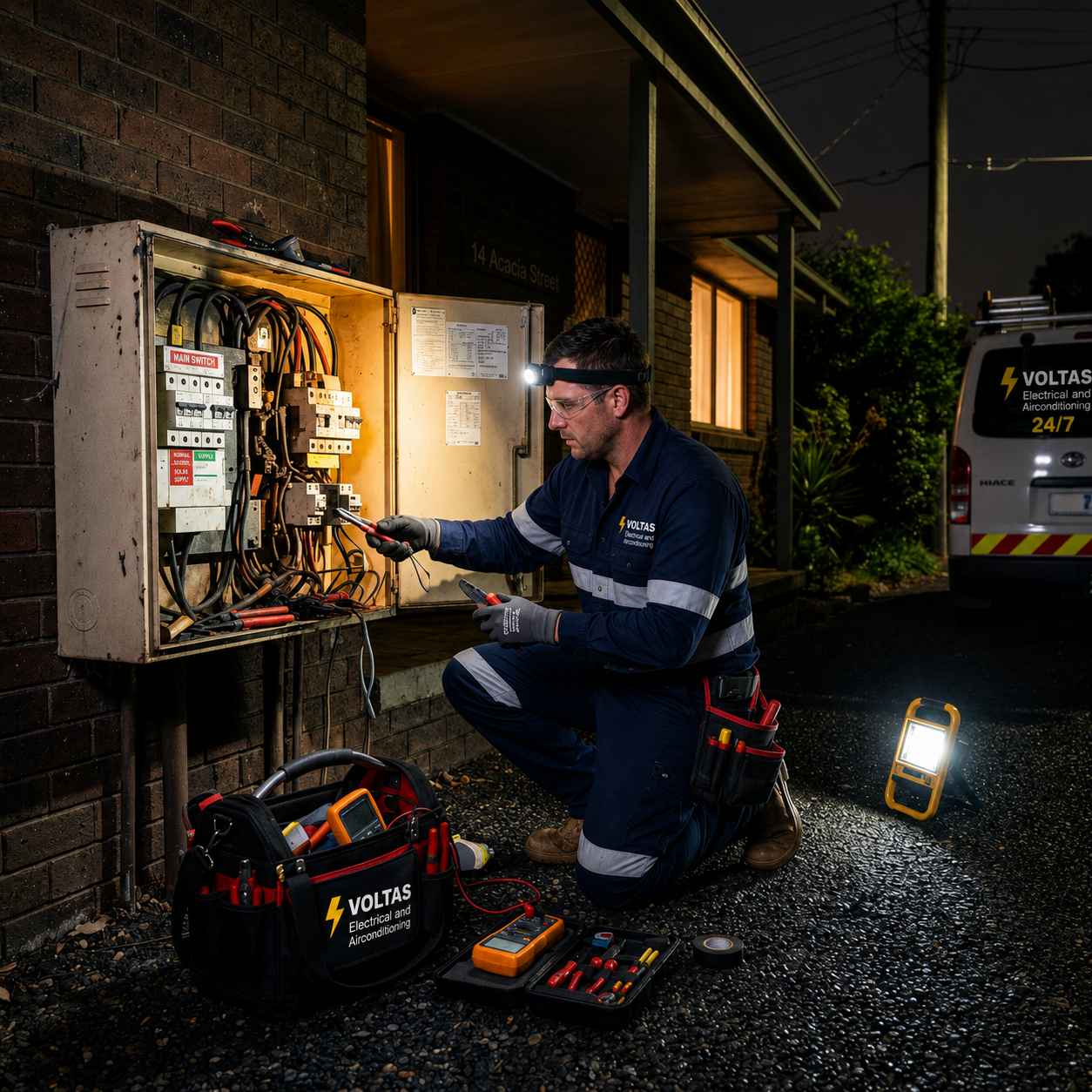
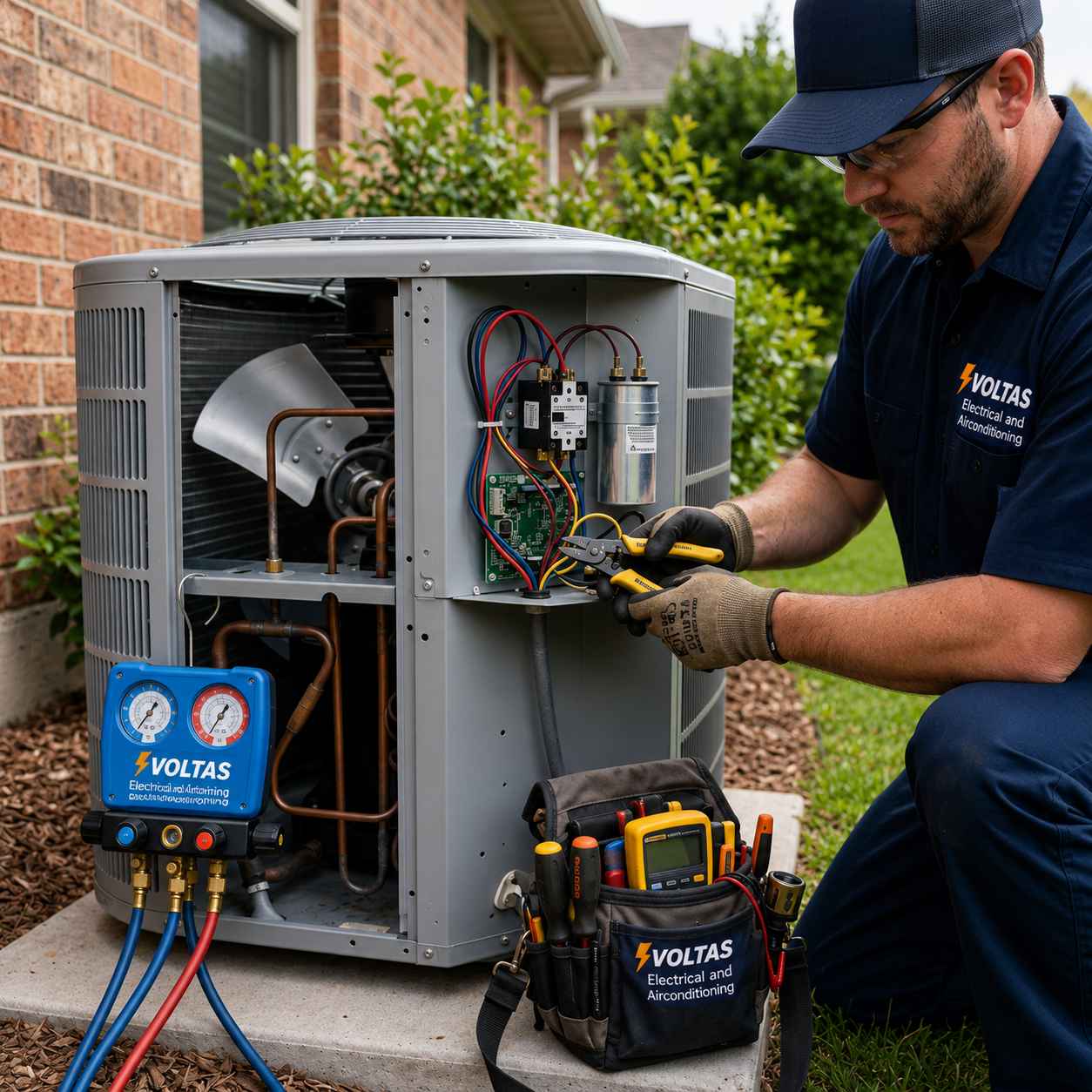
Most electrical faults don't announce themselves with a bang. They show up as small, easy-to-dismiss annoyances first — a light that flickers when the kettle boils, a power point that feels a little warmer than the one next to it, a safety switch that trips slightly more often than it used to. On their own, each of these can have an innocent explanation. Together, or if any one of them is getting worse rather than better, they're your home's wiring telling you something is wrong behind the wall.
We're Voltas Electrical & Airconditioning, a licensed Adelaide electrical team (licences BLD 274739, PGE 265145, AU 61210) that diagnoses electrical faults across Adelaide metro every week, with 24/7 emergency response and same-day appointments the norm rather than the exception. This guide covers the seven warning signs worth knowing, why Adelaide's older housing stock makes faults more common here than in newer suburbs, and how to tell the difference between "call now" and "book an inspection."
7 Warning Signs of an Electrical Fault
None of these signs are automatically a full-blown emergency, but each one is a genuine reason to get your wiring looked at rather than waiting to see if it gets worse.
1. Flickering or dimming lights
A light that flickers or dims when another appliance switches on can point to a loose connection or an overloaded circuit, not just an ageing globe.
2. Power points or switches that feel warm
Warmth at a switch or outlet means a loose connection or overloaded circuit is generating heat behind the wall — a genuine fire risk, not a quirk of the fitting.
3. A burning or hot-plastic smell
Treat this as urgent. Switch off the circuit at the switchboard if it's safe to do so and call an emergency electrician immediately — don't wait for a scheduled visit.
4. A safety switch or fuse that trips repeatedly
An occasional trip from a faulty appliance is normal. Frequent, unexplained trips usually mean a deeper fault in the circuit itself.
5. Buzzing or crackling sounds
A buzzing power point, light switch, or switchboard is arcing electricity trying to find a poor connection — it should never be audible from a healthy circuit.
6. Discoloured or scorched outlets
A yellowed, browned, or visibly scorched power point or switch plate has already been overheating, even if it isn't warm to touch right now.
7. Appliances behaving erratically
Appliances that randomly shut off, restart, or run inconsistently on a particular circuit are often reacting to unstable voltage from a fault upstream, not a problem with the appliance itself.
Noticed more than one of these at once? That combination is worth a proper diagnosis, not a guess.
Book a Same-Day InspectionWhy Older Adelaide Homes Are More Prone to Electrical Faults
Adelaide has one of the oldest housing stocks of any Australian capital, with entire suburbs of homes built well before current wiring standards existed. A significant share of that stock still carries its original wiring, insulated with rubber, cloth, or cotton rather than today's PVC. That insulation was perfectly acceptable when it was installed decades ago, but it dries out, cracks, and becomes brittle over time — which is exactly the kind of degradation that shows up as buzzing, warm outlets, or a burning smell when a fault finally develops.
It isn't only the cabling. Switchboards in pre-1980s Adelaide homes were often built with ceramic fuses instead of circuit breakers and, in many cases, no safety switches (RCDs) at all — a setup that was standard when installed but is a genuine safety gap by today's AS/NZS 3000 Wiring Rules. Modern households also run far more on a single circuit than these homes were ever designed for — ducted air conditioning, induction cooktops, EV chargers, multiple entertainment systems — and pushing decades-old wiring and an undersized switchboard past its original design load is one of the most common ways a slow-building fault turns into an urgent one. If your switchboard itself looks dated rather than just the wiring, our guide on when to upgrade your switchboard covers the specific signs to look for there, and our signs your home needs a full rewire article covers what to do when the cabling itself, not just the board, is the problem.
Emergency Call-Out or Routine Inspection? How to Decide
Not every warning sign needs a 2am call-out, but some genuinely do. Getting this right matters both for safety and for cost — an unnecessary after-hours call-out is an avoidable expense, while delaying a genuine emergency is a real safety risk.
Call an emergency electrician immediately if: you smell burning or hot plastic anywhere in the house, you see visible sparking or smoke, you or anyone in the house has felt a shock from touching a switch or appliance, or you've lost power entirely to an essential circuit (fridge, medical equipment, security system). Our emergency electrical repairs team runs 24/7 across Adelaide metro for exactly this kind of situation, with a technician typically on-site within one to two hours.
A same-day or next available appointment is usually enough if: a single light flickers occasionally, one power point feels marginally warm with no other symptoms, or your safety switch has tripped once or twice without a clear pattern. It's still worth booking promptly rather than letting it slide — our electrical fault finding & repair service diagnoses the actual cause rather than just resetting the switch and hoping it doesn't happen again, and same-day appointments are the norm across our service area, not the exception.
What a Professional Fault Diagnosis Actually Involves
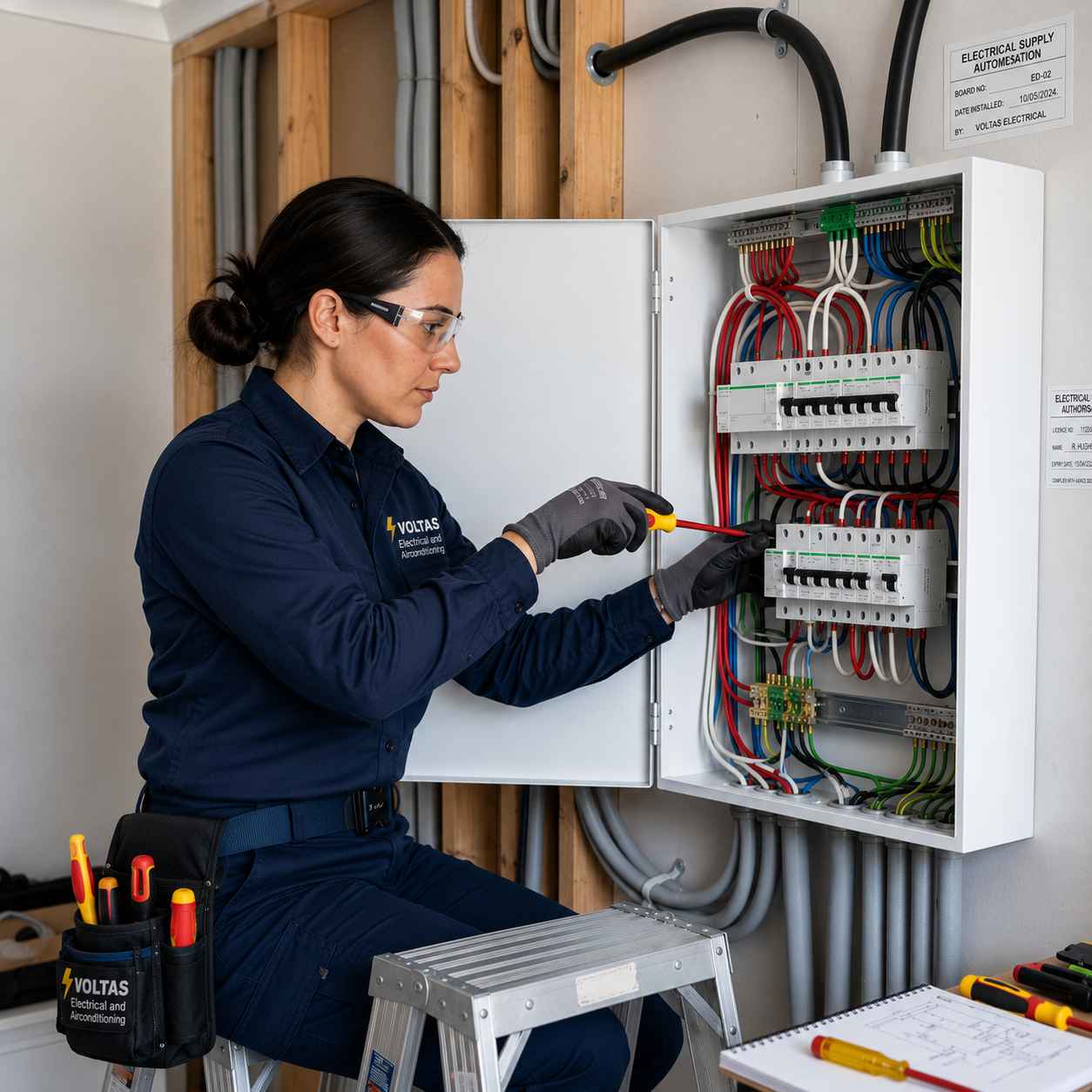
A proper fault-finding visit starts with isolating which circuit is affected, then testing insulation resistance, earth continuity, and connection points along that circuit to find exactly where the fault sits — rather than replacing parts on a guess. In an older Adelaide property this often means checking the switchboard, roof space wiring, and any accessible wall cavities, since a fault in one part of an ageing circuit is frequently a sign the same wiring elsewhere is close behind it. Every repair we carry out comes with a workmanship guarantee and, for any new or altered wiring, an electronic Certificate of Compliance (eCoC) as required under South Australian regulation — documentation that also matters if you ever need to show an insurer the work was done by a licensed electrician to current standards.
We see this pattern most often in Adelaide's older, established suburbs — areas like Norwood, Unley, and Prospect, where original housing stock from well before the 1980s is common — as well as in North Adelaide's character homes. If your property falls into that category and hasn't had a documented electrical upgrade in decades, a fault showing up now is a reasonable prompt to get the wiring properly assessed rather than just fixing the one symptom you noticed.
Frequently Asked Questions
What are the warning signs of an electrical fault in my home?
The main warning signs are flickering or dimming lights, power points or switches that feel warm to touch, a burning or hot-plastic smell, a safety switch that trips repeatedly, a buzzing or crackling sound from an outlet or the switchboard, discoloured or scorched power points, and appliances that behave erratically for no obvious reason. Any one of these is worth having checked by a licensed electrician.
Is a burning smell from a power point an emergency?
Yes. A burning-plastic or hot smell near a power point, switch, or the switchboard means insulation or a connection is already overheating, which is a genuine fire risk. Switch off the circuit at the switchboard if it's safe to do so, avoid touching the point again, and call an emergency electrician immediately rather than waiting for a scheduled appointment.
Why do older Adelaide homes have more electrical faults?
Adelaide has one of the oldest housing stocks of any Australian capital, and many homes built before the 1980s still contain original wiring insulated with rubber, cloth, or cotton rather than modern PVC. That insulation naturally dries out, cracks, and becomes brittle with age, and older switchboards were built for far fewer appliances than a typical household runs today, so faults show up more often as the electrical system is pushed past what it was designed for.
Should I call an emergency electrician or book a routine inspection?
Call an emergency electrician immediately for a burning smell, visible sparking, smoke, a shock from touching an appliance or switch, or total loss of power to essential circuits. For a safety switch that trips occasionally, a single flickering light, or a power point that feels slightly warm but shows no other symptoms, a same-day or next-day inspection is usually the right call rather than an after-hours emergency visit.
Not Sure If What You're Seeing Is Serious?
Tell us what you've noticed and we'll help you work out whether it's urgent, and get a licensed electrician out to assess it — same-day, across Adelaide metro.
Guidance cross-checked against current AS/NZS 3000 Wiring Rules requirements and South Australia's Office of the Technical Regulator and Certificate of Compliance guidance (SA.GOV.AU), plus our own trade experience diagnosing faults across Adelaide's older housing stock. For a deeper look at wiring or switchboard age specifically, see our guides on signs your home needs a full rewire and when to upgrade your switchboard.
Disclaimer: This article is provided as general information and guidance only. It draws on publicly available sources, government and industry publications (referenced where relevant), and Voltas Electrical Adelaide's own trade experience — it is not personalised advice for your specific property and does not replace a licensed, on-site assessment. Regulations, pricing, and product or brand details can change over time, so please independently verify anything relevant to your decision and seek your own professional advice before acting. To the fullest extent permitted by law, Voltas Electrical Adelaide accepts no responsibility or liability for any loss, damage, or other outcome arising from reliance on the information in this article. Where this article refers to a same-day or obligation-free quote or assessment, that refers to the quote or assessment itself — a site visit to a property well outside our normal Adelaide metro service area may incur a travel or call-out fee, as set out in our Terms & Conditions, which also has full details on the points above.